
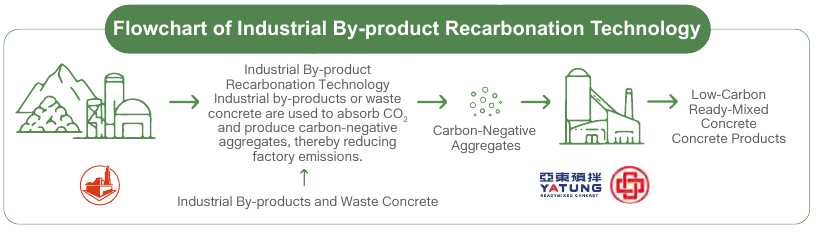
Asia Cement uses safe, calcium oxide-rich industrial by-products and waste as media for CO₂ absorption. Through high-gravity recarbonation and sequestration, these materials can be converted into carbon-negative recycled aggregates or supplementary cementitious materials (SCMs), supporting both process decarbonization and resource recovery.
High-Gravity Carbon Sequestration Technology
Asia Cement’s Hualien Plant completed construction of its high-gravity carbon sequestration system in early 2025. Tests showed that each metric ton of industrial by-products or waste could sequester up to approximately 200 kg of CO₂. The next phase is a parallel pilot-scale system targeting a carbon capture and utilization capacity of 50 kg CO₂ per hour, with automated control and continuous operation.
Medium- and Long-Term CCU Targets
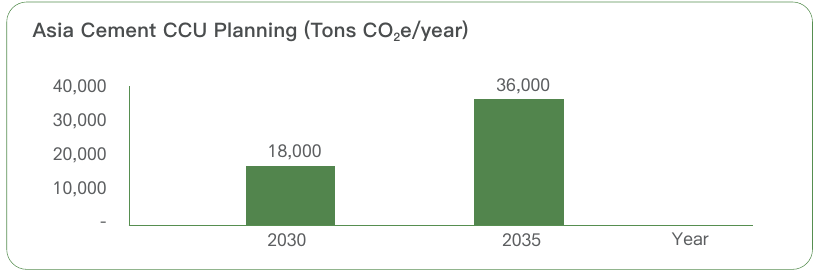
Asia Cement plans to reach an annual carbon capture and utilization capacity of 18,000 metric tons of CO₂ by 2030, with a target of 36,000 metric tons by 2035.
Ya Tung Ready-Mixed Concrete’s Dry Circulation Carbon Sequestration
Ya Tung Ready-Mixed Concrete uses superabsorbent polymer (SAP) to reduce the treatment time for ready-mixed concrete remnants from one hour to 15–20 minutes. The dried aggregates are screened and reused. Tests showed that incorporating 15% recycled aggregates had no significant impact on concrete quality.
In 2025, Ya Tung Ready-Mixed Concrete obtained a patent for its “Method for Carbon Sequestration Using Flowable Concrete Remnants.” Approximately 60–80 kg of CO₂ can be sequestered per cubic meter of remnants. This enables an additional carbon reduction of more than 18% for its low-carbon concrete products, on top of the existing 50% reduction.